The ledger is free. That's the trap.
Everything Voss wrote down sits on your desk at no charge: the trial balance (every account's total, where debits should equal credits) and every ledger entry for June. Read it all day if you like.
The trouble is that he wrote it. So the game hands you a drawer of documents he didn't write, each with a price on its face in billable hours:
- The bank statement4h
- The register tape3h
- A vendor file2h
- A single invoice1h
Spoiler for the demo above, if you scrolled past it:
Your retainer for the café is 16 hours. The $349.00 entry is a check to Crestline Supply Co., and there's one more check to them on June 5. Pull Crestline's vendor file and it says NO RECORD. Pull the bank statement and both checks cleared, endorsed R. VOSS.
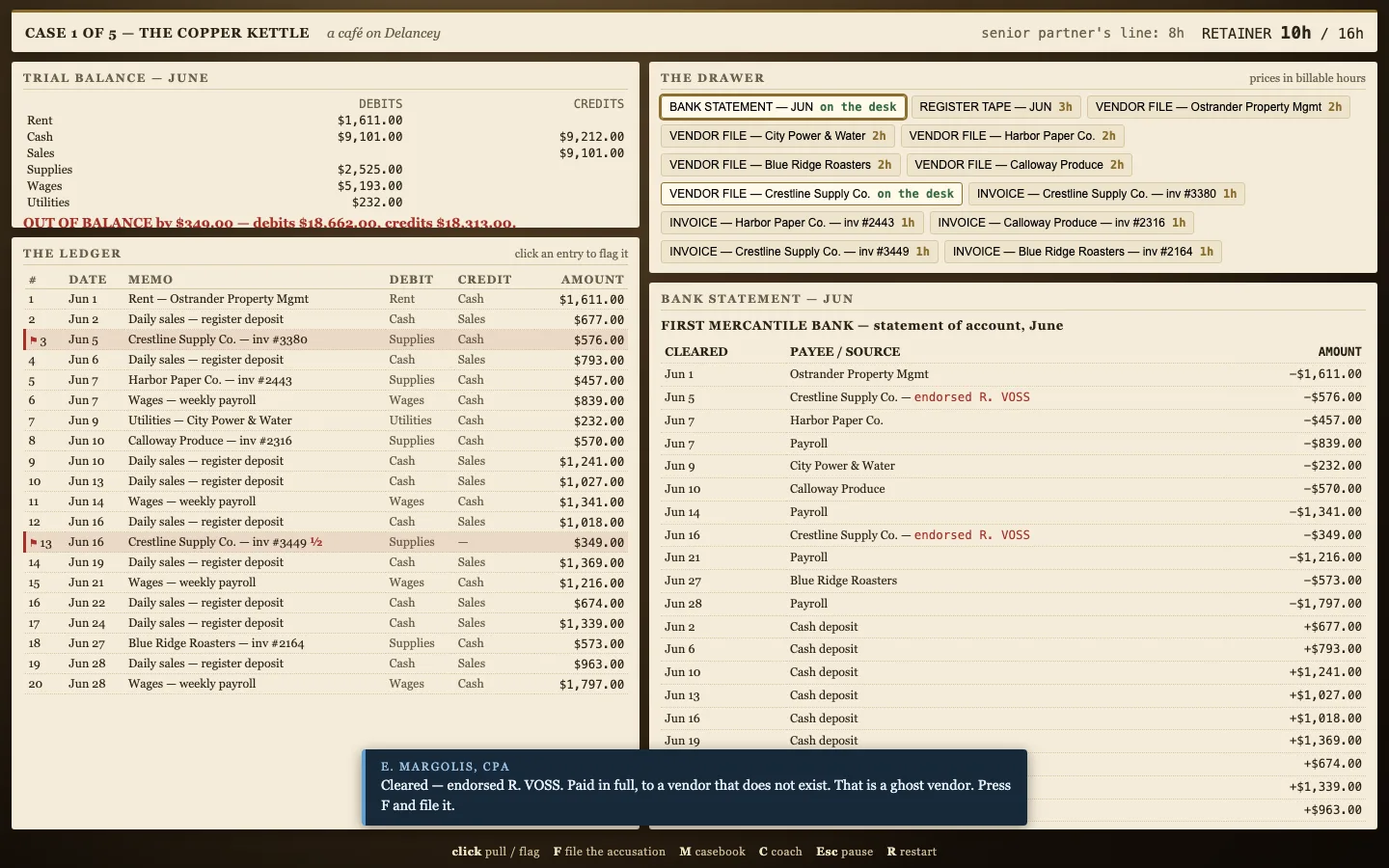
That's 6 hours of paper and a 2-hour filing. The senior partner's line for this case is 8 hours. Pull the invoice too, out of curiosity, and you've billed 9. You still caught him, but the client noticed.
Every pull is a question you pay to ask.
You need to know two things about accounting
First, the books record what someone said happened. Second, documents from outside (a bank, a cash register, a supplier) record what they saw. In this game, when the two disagree, it isn't timing and it isn't a bank error. Somebody lied, and it wasn't the bank.
That's it. You don't need debits and credits. The ledger has columns for them, but the game never asks you to post an entry. It isn't accounting training, either. It's a puzzle that happens to be made of paperwork.
E. Margolis, CPA, the senior partner, walks you through case 1 one step at a time and only moves on when you do the thing. After that she gives you one hint per case and goes quiet.
Case 2 is where she stops talking. Its books balance perfectly, and her one hint is the best line in the game: "Balance proves the arithmetic, not the truth."
Press M any time for the casebook: the four schemes, a sentence or two each.
Guess, and it bills you
Obra Dinn checks your answers in threes. This one sends you an invoice.
You can accuse anyone of anything. Every filing costs 2 hours, and a wrong one costs 3 more. What I like is what you get for the 5 hours: a wrong filing stamps that party RECONCILED (the game's word for cleared) and tells you why, in one line: "Harbor Paper Co. reconciles: 1 payment, 1 document on file, every dollar accounted for." Accuse the right party of the wrong scheme and that scheme gets struck. So a miss is expensive evidence, not a game-over screen.
Name the right party and the right scheme but cite the wrong entries, and it says so: "Right neighborhood, wrong paper." Nobody gets cleared on that filing, because nothing was disproven.
If you run low on hours, your last filing is free. The case ends either way, and the next client's file opens. Nobody gets stuck.
"The bank does not record intentions."Footer of every bank statement in the game
Five clients, four schemes
| # | Client |
|---|---|
| 1 | THE COPPER KETTLEa café on Delancey |
| 2 | MEL'S LUNCH COUNTERa diner by the depot |
| 3 | TRUE NORTH OUTFITTERSan outdoor-gear shop |
| 4 | BRIGHTWATER MARINAa marina up the coast |
| 5 | MOEHR HOLDINGS LLCVoss's biggest client, and the biggest ledger in the game |
Which client got which scheme is the game, so I'm not printing it. Here are the four, in the casebook's own words:
"Payments to a vendor that does not exist. The checks are real and somebody cashed them; the goods never were."
"Cash taken out of the till before it was ever written down. The books balance because the theft happened before the books."
"Money sent out as a cost that comes straight back in dressed as income. The business looks busier; nothing was ever earned."
"Real purchases, real invoices…"
"Signature: the invoice's line items don't belong to the account they were booked to."
Every document is read off one model of what really happened that month. Change the month and every document follows.
Three stars, and they mean different things
- THE FINDING: right party, right scheme, and the right entries cited, before the case closes.
- THE CITATIONS: every fraudulent entry cited, nothing clean.
- THE BILL: at or under the senior partner's line, with no wrong filings.
Every case has a clean line, and padding past it costs you. All three stars is A CLEAN FILING. The game ships bots that play through the same buttons you do, and I ran them on 100 months of all five cases:
- I gave one bot the answer key and told it to pull only what proves it. It got 3 stars on 500 of 500, so every case has a clean line.
- Give it three extra documents and it loses THE BILL, every time.
- Have it cite one innocent entry and it loses THE CITATIONS, every time.
Can you guess? Sure. A guess is just a filing, and filings cost 5 hours when they're wrong.
Bots, not people. The bots themselves are in the game's source, at /play/src/sim/hands.js.
Free. No account. Desktop or laptop.
For the accountants reading this
It's a game, and it simplifies. Here's where.
What it models honestly: the books and the documents come from the same underlying month. Every case has exactly one fraud, and the game's test suite proves (726 checks, every case across six different months) that the full paper trail points at that one and clears everyone else. Amount discrepancies are at least $75.00, so it never makes you squint at pennies.
What it simplifies:
- One month, one fraud, no opening balances.
- Case 1's books are out of balance on purpose (Voss stopped mid-entry). A competent ghost vendor balances.
- The bank statement prints who endorsed a check. Yours doesn't.
- The trial balance shows Cash as gross debits and credits.
- The senior partner's line is computed by the game with hindsight: the cheapest set of documents that proves the fraud.
- The round-trip has no theft in it. It inflates revenue, and the game doesn't say what Voss got for it.
- A CFE would call the skimming case cash larceny, since the register rang the sales up. The casebook calls it skimming. I think that's a fair simplification, but I'd rather you hear it from me.
Honest gripes
- It's five cases. When you finish MOEHR HOLDINGS LLC, that's the game, though you can replay it on a different month.
- No sound.
- The full game needs a real screen. The ledger and the documents sit side by side, and on a phone they don't fit.
- On the default month, case 5 draws the same scheme as case 4.
- Nobody outside the build has played it yet, so I can't tell you how long it takes.
Questions
- Do I need to know accounting?
- No. You compare names and amounts across documents. Case 1 walks you through the rest.
- Is it free?
- Yes. No account, no ads, nothing to buy.
- Can I play on my phone?
- On this page, yes. The full game, not really: it's built for a desktop or laptop.
- How long is it?
- Five cases. Each one is a ledger of 16 to 31 entries and a drawer of 10 to 27 documents, depending on the month. Nobody has timed it yet.
- Does it save?
- It remembers which cases you've opened and your best stars, in this browser. Solve case 1 on this page and the full game opens on case 2.
- Can I play a different month?
- Yes. Open
/play/?fresh&seed=12(any number works): new amounts, new days, and usually a different scheme in case 5. Thefreshpart starts you at case 1 and wipes your stars, so bookmark/play/?seed=12without it to come back later. R restarts the case you're on. - Is the fraud ever ambiguous?
- No. One fraud per case, and the paper has to prove it. That's what the 726 checks are for.